

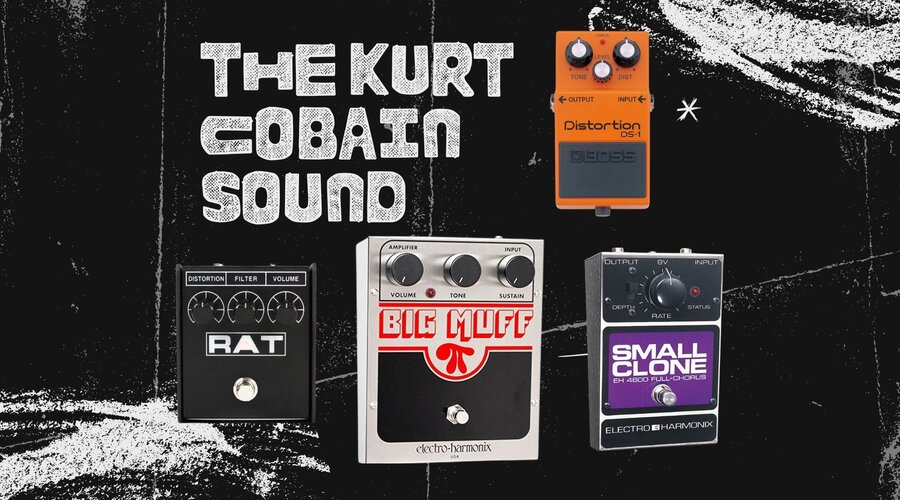
Getting Kurt Cobain’s guitar sound isn’t about chasing boutique pedals or massive boards—it’s about raw simplicity, contrast, and attitude. Kurt’s tone lived in the extremes: brutally clean verses, explosive distorted choruses, and noisy textures that felt barely contained. The pedals he used reflected that philosophy.
At the core of Kurt’s sound is distortion—specifically the Boss DS-1 Distortion (and later the DS-2 Turbo Distortion). This pedal defined the aggressive, buzzy crunch heard on Nevermind. The DS-1 is bright, grainy, and unapologetic, with a jagged edge that cuts through a mix rather than smoothing things out. Kurt typically ran it into a loud, clean-ish amp, letting the pedal do most of the work. If you want that ripping “Smells Like Teen Spirit” or “Breed” rhythm tone, this is non-negotiable.
Next up is chorus, and this is where the magic of Nirvana’s quiet parts happens. Kurt relied heavily on the Electro-Harmonix Small Clone. This pedal gave his clean tone that watery, seasick movement heard on songs like “Come As You Are,” “Lithium,” and “In Bloom.” He generally used it subtly—depth switch engaged, rate set slow—just enough to add motion without sounding lush or polished. The Small Clone’s slightly dark, analog character is a big reason those parts feel moody and unsettling rather than pretty.
For clean boost and grit, Kurt often used a Pro Co RAT, especially in the Bleach era. The RAT sits somewhere between distortion and fuzz, with a gritty midrange bite and a rough, unrefined edge. While it wasn’t always on his board later, it’s essential if you’re chasing early Nirvana tones like “Blew” or “School.” It’s less scooped than the DS-1 and more snarling and aggressive.
Fuzz wasn’t a constant, but it showed up in key moments. Kurt occasionally used the Electro-Harmonix Big Muff, especially in the studio, to create thick, blown-out walls of sound. It’s less defined than his distortion pedals but perfect for chaotic textures and noise-heavy sections.
Speaking of noise—feedback and chaos were part of the sound, not accidents. Kurt didn’t rely heavily on modulation, delay, or reverb pedals. Instead, he let loud amps, pedal gain, and stage volume do the work. That raw interaction between guitar, pedals, and speakers is crucial to getting the feel right.
If you want to build a true Cobain-inspired board, keep it simple:
-
Boss DS-1 or DS-2 (main distortion)
-
EHX Small Clone (chorus)
-
Pro Co RAT (optional, early-era grit)
-
Big Muff (optional, noise and texture)
More important than the pedals themselves is how you play: heavy-handed strumming, dynamic shifts, and zero concern for “perfect” tone. Kurt’s sound wasn’t about polish—it was about honesty, volume, and emotion. Plug in, turn it up, and don’t overthink it.
Leave a comment